
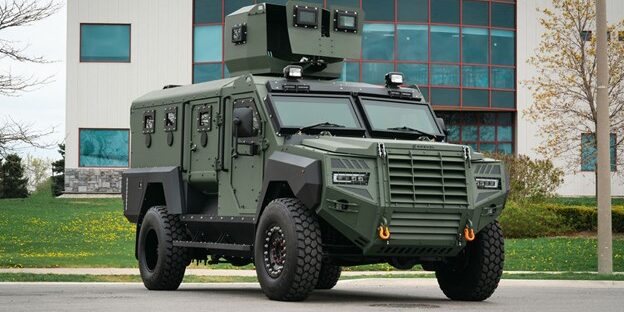
Roshel Smart Armored Vehicles, which operates its primary production facility and head office at 255 Biscayne Crescent in Brampton, is expected to be one of the firms supported by rising defence investment in Canada.
Overview
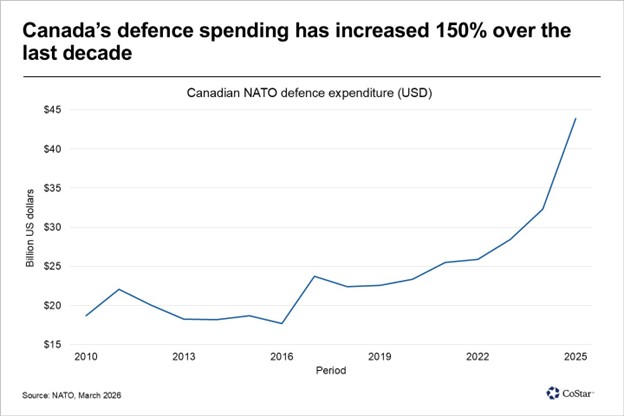
Canada’s recent increase in defence spending represents a significant departure from the relatively stable funding levels seen over the past decade. The latest federal budget indicates that this shift is not temporary, but rather a long-term policy direction aimed at strengthening domestic production capabilities.
This strategic change has potential implications for industrial real estate, particularly in manufacturing-oriented markets within the Greater Toronto Area.
Policy Shift Toward Domestic Production
The federal government’s newly introduced Defence Industrial Strategy connects national security priorities with economic development. The policy emphasizes expanding Canadian-based production across key sectors, including:
- Aerospace
- Advanced manufacturing
- Digital and defense-related technologies
This approach signals a sustained effort to localize supply chains and increase domestic production capacity, which may translate into future demand for industrial space.
Impact on GTA East Industrial Market
The eastern portion of the GTA—particularly the Durham Region—has historically functioned as a manufacturing hub and may be well positioned to benefit from this shift.
Since March 2022, when rising interest rates began to slow industrial demand:
- Approximately 9.4 million square feet of industrial space has been added in the GTA East submarket
- Around 23% of this new supply is manufacturing-focused, the highest proportion across all GTA industrial submarkets
Despite this, leasing activity has been constrained due to:
- Trade uncertainty
- Ongoing tariff-related challenges
- Broader pressure on the manufacturing sector
Defence Manufacturing as a Demand Driver
Increased defence investment could introduce a more stable, policy-driven source of industrial demand, less tied to traditional economic cycles.
Defence-related manufacturing typically requires:
- High-quality, modern facilities
- Increased power capacity
- Enhanced security infrastructure
- Access to skilled labour
These specifications align closely with many of the newer industrial developments in GTA East, particularly those built with manufacturing capabilities in mind.
Market Outlook
While there is currently no significant evidence of defence-related leasing activity in market data, the federal government’s long-term commitment to domestic production is a positive indicator.
Submarkets with a higher concentration of manufacturing space—such as GTA East—may be better positioned to capture this emerging demand.
In the near term, broader manufacturing conditions remain under pressure. However, over the medium term, increased defence spending could help offset some of this softness by introducing a consistent and structurally supported source of demand.
The combination of:
- Sustained federal defence investment
- A high concentration of manufacturing-ready industrial supply
- Current market softness
positions GTA East as a submarket with potential to benefit from future demand tied to domestic defence production.
While the impact is not yet visible in leasing trends, the underlying policy direction suggests a gradual stabilization effect for manufacturing-oriented industrial assets.


